October 15, 2026
Wellness trends 2027: 97% of consumers are prioritizing their wellness in the new year

In the lowEvery January, gyms fill up, junk food disappears from grocery carts, and the supplement aisle gets busy as consumers embrace their best selves in the new year. It’s a new day in the wellness industry, with advancements in GLP-1s, peptides, and supplements promising a healthier future for all. With that much choice (and that much noise in the supplement aisle), what are consumers actually planning to do for their health this year, and who are they trusting to help?
To find out, we surveyed 1,002 U.S. consumers about their wellness goals, spending, supplement habits, and where they shop. We also dug into a year of U.S. search data to see which health topics are picking up speed. Here’s what we found.
Health goal statistics for 2027: 76% of consumers want to improve their physical health
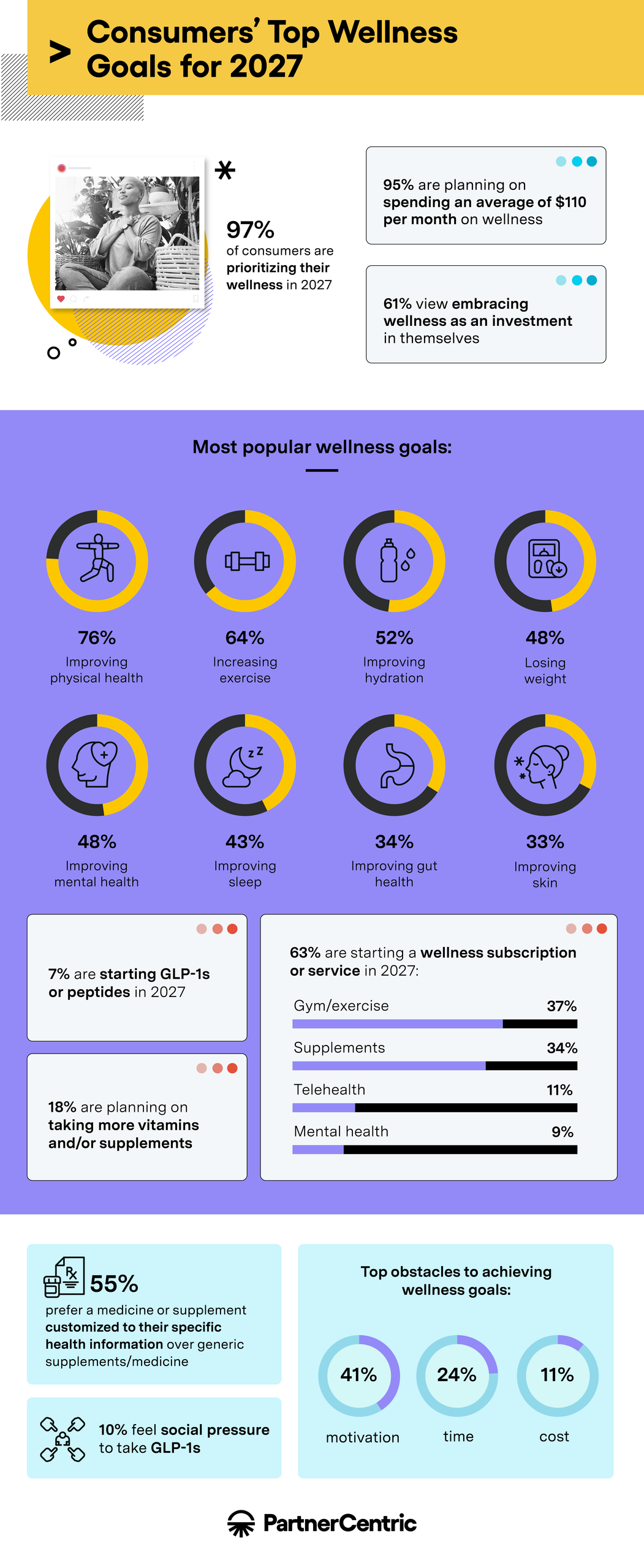
Nearly every consumer we surveyed (97%) is prioritizing their wellness in 2027, and 61% view it as an investment in themselves. The statistics show they’re backing that up with a budget: 95% plan to spend on wellness next year, at an average of $110 per month, or roughly $1,320 over the year. In a time of skyrocketing cost of living, this budget represents a true priority for consumers.
So what does “wellness” mean to them? For most, it starts with the body. Improving physical health is the most popular 2027 wellness goal (76%), followed by increasing exercise (64%), improving hydration (52%), losing weight (48%), and improving mental health (48%). Better sleep (43%), gut health (34%), and skin (33%) round out the list.
Consumers are signing up, too. Nearly two thirds (63%) are starting a wellness subscription or service in 2027, most often a gym or exercise membership (37%) or a supplement subscription (34%), with telehealth (11%) and mental health services (9%) further down the list. Another 18% plan to take more vitamins and/or supplements. As befits the era of customized feeds, consumers want their wellness bespoke, too: 55% prefer a medicine or supplement customized to their specific health information over generic supplements or medicine.
Motivation is the top obstacle to achieving wellness goals (41%), well ahead of time (24%) and cost (11%). Consumers have the intent and the budget; keeping the momentum going past January is the hard part.
Peptides and GLP-1s: search interest is surging, but just 7% of consumers plan to start in 2027
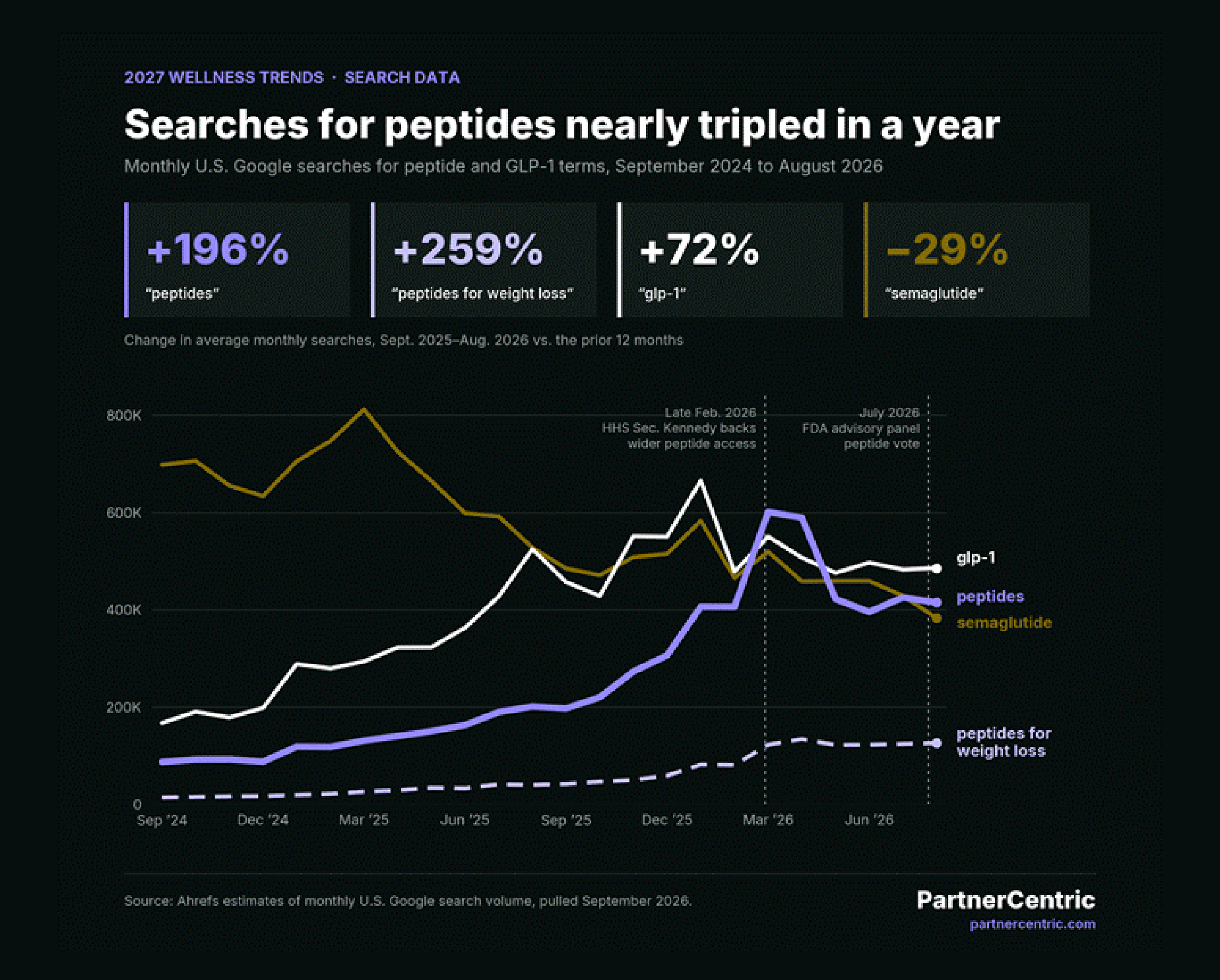
Peptides were one of the fastest-growing health searches we tracked this year. According to Ahrefs search data, U.S. Google searches for “peptides” averaged about 388,000 per month between September 2025 and August 2026, up 196% from about 131,000 per month the year before. Searches for “peptides for weight loss” grew even faster, up 259% to about 93,000 per month.
GLP-1s are still climbing as well. U.S. searches for “glp-1” averaged about 511,000 per month over the same period, up 72% year over year, and searches for “wegovy” rose 49%, with the biggest jump arriving in January 2026, shortly after the FDA approved the first GLP-1 pill for weight management. Meanwhile, searches for “ozempic” fell 23% and “semaglutide” fell 29%.
How consumers find wellness brands in 2027: doctors (30%) outrank search and AI
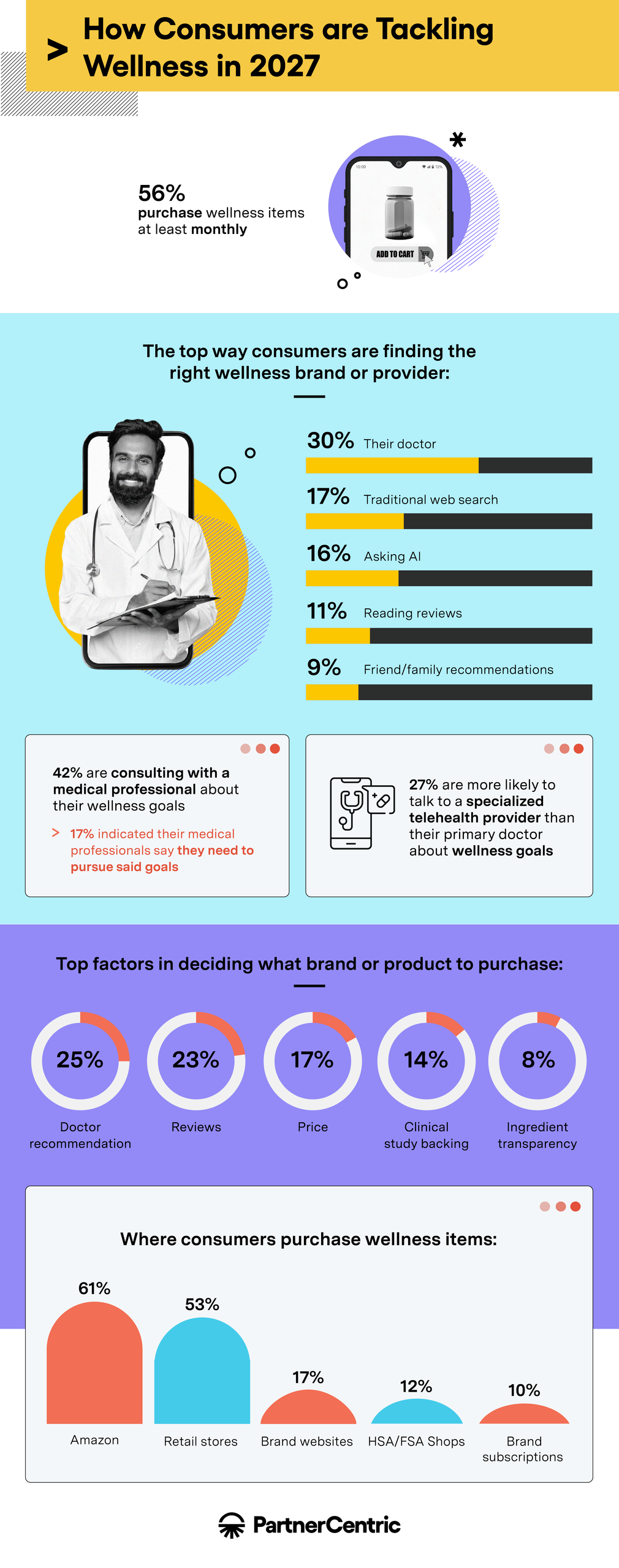
Wellness is also a year-round mindset: more than half of consumers we surveyed (56%) buy wellness items at least monthly. That being said, the funnel starts at the doctor’s office: 30% find the right wellness brand or provider through their doctor, ahead of traditional web search (17%), asking AI (16%), reading reviews (11%), and friend or family recommendations (9%).
Consumers are turning to AI and traditional search at nearly equal rates, signaling a growing reliance on AI for personalized shopping recommendations. That tracks with our AI shopping research, where 41% of consumers said they planned to use AI shopping for health and supplements in 2026.
Medical professionals shape a lot of these decisions. Statistics show 42% of consumers are consulting with a medical professional about their wellness goals, and 17% require seeing a medical professional in order to move forward, as in the case of those seeking GLP-1s or other medications. Still, 27% are more likely to talk to a specialized telehealth provider than their primary doctor about wellness goals, a sign that convenience and specialization are pulling some of those conversations online.
A doctor recommendation is the top factor in deciding which wellness brand or product to buy (25%), followed closely by reviews (23%), then price (17%), clinical study backing (14%), and ingredient transparency (8%). Price lands in third place, behind two measures of credibility.
When it’s time to buy, consumers mostly stick to where they already shop. Amazon leads (61%), followed by retail stores (53%), while brand websites (17%), HSA/FSA shops (12%), and brand subscriptions (10%) trail well behind. With so few purchases happening on brand sites, the reviews and content publishers that shoppers read on the way to Amazon carry weight.
Supplement trends: 80% take vitamins or supplements, primarily for sleep
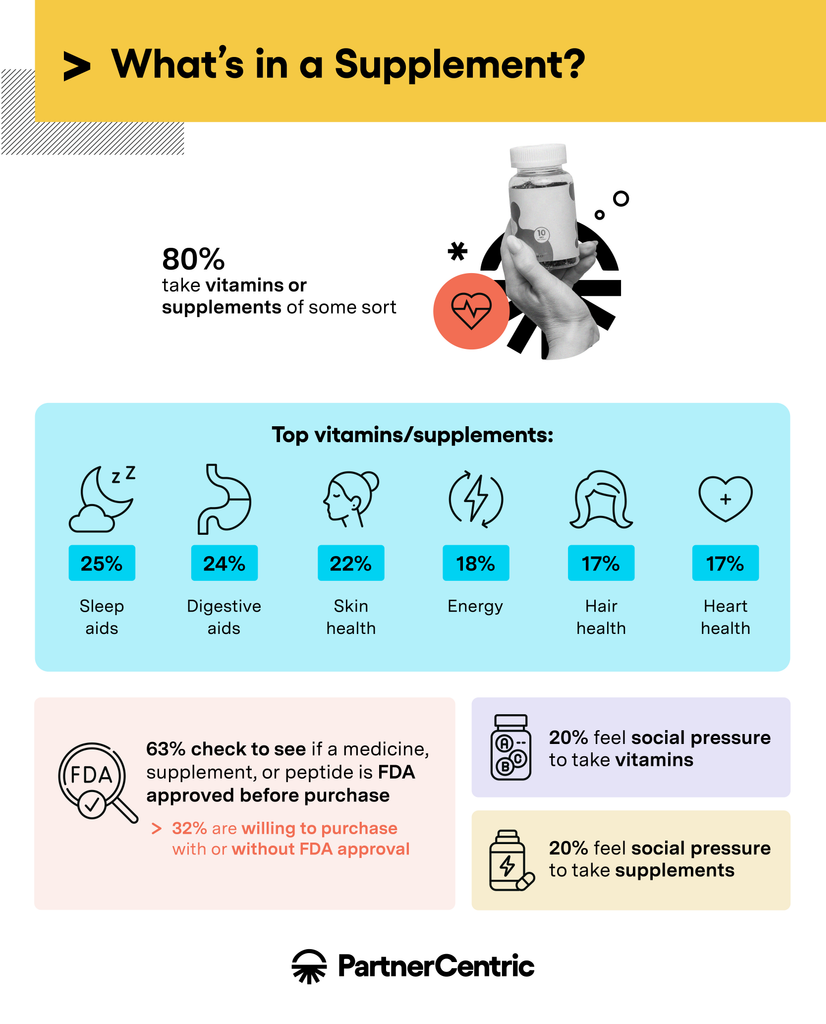
Supplements are close to universal among the consumers we surveyed: 80% take vitamins or supplements of some sort. Sleep aids are the most popular category (25%), followed by digestive aids (24%), skin health (22%), energy (18%), hair health (17%), and heart health (17%). The top two line up with the sleep and gut health goals consumers named for 2027, so people already seem to be buying for their New Year’s resolutions.
Most shoppers also say they check the fine print. 63% check to see if a medicine, supplement, or peptide is FDA approved before purchase, while 32% are willing to purchase with or without FDA approval. For supplements, that check has a catch: the FDA doesn’t approve dietary supplements for safety and effectiveness before they’re sold. Shoppers looking for that approval on a supplement label won’t find it.
The same question is showing up in search, and it’s growing fast. U.S. Google searches for “fda approved peptides” averaged about 3,100 per month between September 2025 and August 2026, more than nine times the roughly 330 per month the year before (+822%), according to Ahrefs data.
Some of this buying is social. One in five consumers feels social pressure to take vitamins (20%), and the same share feels social pressure to take supplements (20%). That’s a reminder that wellness products spread through feeds and group chats as well as doctor’s offices, a dynamic we’ve also explored in our influencer trust research.
Wellness by generation: 47% of Gen Z feel social pressure to consume wellness items
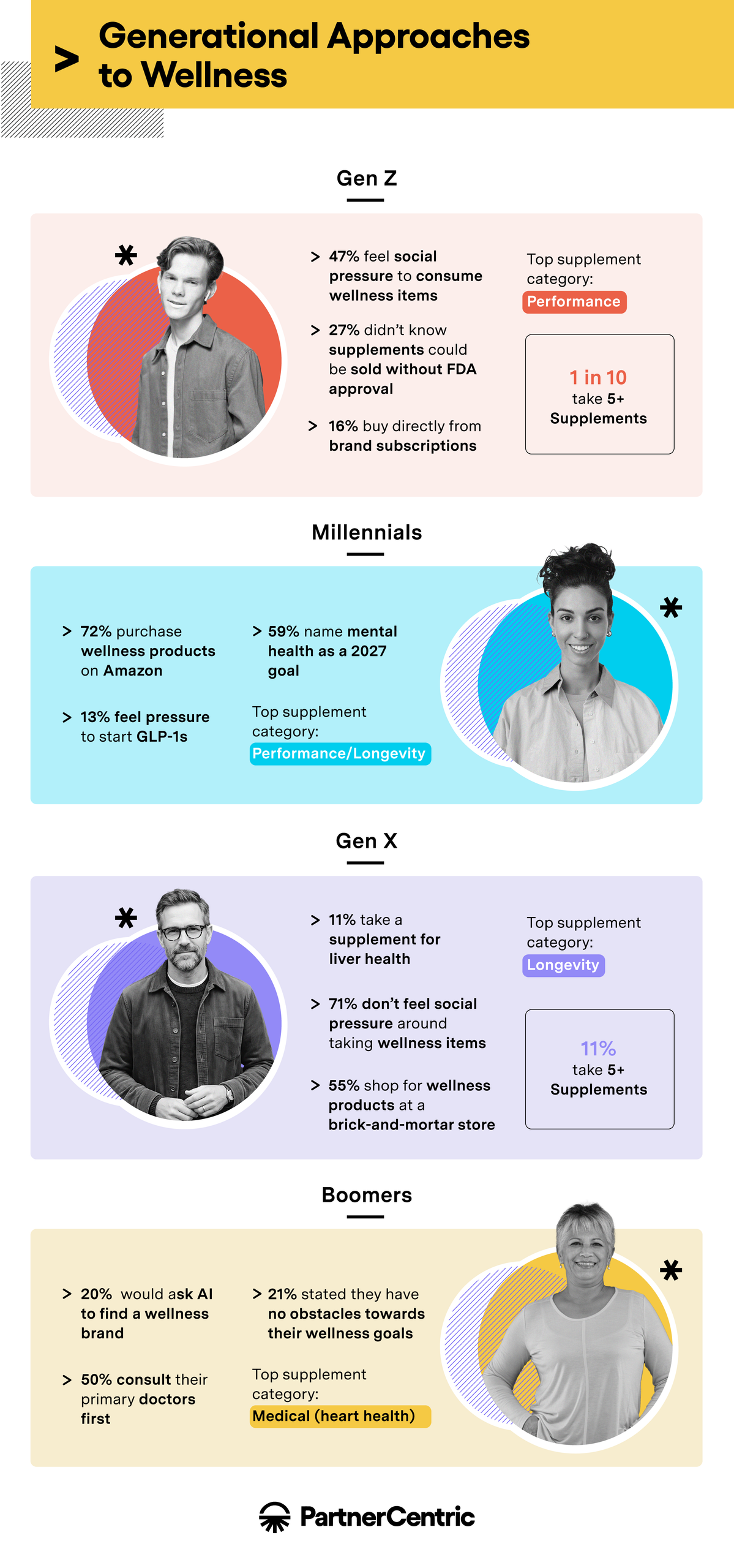
Each generation has its own approach to wellness in 2027. Gen Z’s top supplement category is performance (think: focus aids), Millennials split between performance and longevity (e.g. collagen and sleep aids), Gen X leans into longevity (e.g. liver supplements for organ health), and Boomers focus on medical needs, led by heart health.
Gen Z also feels social pressure most profoundly. Nearly half of Gen Zers (47%) feel social pressure to consume wellness items, and 1 in 10 take five or more supplements. 16% buy directly from brand subscriptions, compared with 10% of all consumers surveyed.
Millennials are Amazon loyalists: 72% purchase wellness products on Amazon, compared with 61% of all consumers surveyed. They’re also more focused on mental health, with 59% naming it as a 2027 goal versus 48% overall. And 13% of Millennials feel pressure to start GLP-1s, above the 10% of all consumers who feel social pressure to take them.
Gen X does what it does best: its own thing. 71% of Gen Xers don’t feel social pressure around taking wellness items, meaning just 29% do, compared with 47% of Gen Z. More than half (55%) shop for wellness products at a brick-and-mortar store. Longevity is their top supplement category, 11% take a supplement for liver health, and 11% take five or more supplements, on par with Gen Z.
Boomers start with their doctor: half (50%) consult their primary doctors first. They’re open to new tools, though, with 20% saying they would ask AI to find a wellness brand. And 21% of Boomers say they have no obstacles towards their wellness goals.
Frequently Asked Questions
What are the biggest wellness trends for 2027?
The biggest wellness trends for 2027 are personalization, subscriptions, and a surge of interest in peptides and GLP-1s. In PartnerCentric’s survey of U.S. consumers, 97% are prioritizing wellness in 2027, 63% are starting a wellness subscription or service, and 55% prefer medicine or supplements customized to their health information. U.S. Google searches for “peptides” rose 196% between September 2025 and August 2026, according to Ahrefs data.
Are peptides FDA approved?
Some are, but many of the most popular wellness peptides are not. GLP-1 medications such as semaglutide are FDA-approved peptide drugs, while peptides like BPC-157 are not FDA-approved. In July 2026, an FDA advisory committee recommended six peptides, including BPC-157, for compounding, but that recommendation is not an approval. Among U.S. consumers PartnerCentric surveyed for 2027, 63% check whether a medicine, supplement, or peptide is FDA approved before buying.
Are supplements FDA approved?
No. The FDA does not approve dietary supplements for safety and effectiveness before they are marketed. Even so, 63% of U.S. consumers PartnerCentric surveyed for 2027 say they check for FDA approval before buying a medicine, supplement, or peptide, and 27% of Gen Z didn’t know supplements could be sold without FDA approval.
How much do people spend on wellness?
Consumers plan to spend an average of $110 per month on wellness in 2027, or roughly $1,320 a year, according to PartnerCentric’s survey of U.S. consumers. 95% plan to spend on wellness, 56% buy wellness items at least monthly, and 61% view wellness as an investment in themselves. Cost is a top obstacle for just 11%.
What are the most common health goals for 2027?
The most common health goal for 2027 is improving physical health, named by 76% of U.S. consumers PartnerCentric surveyed. Other top goals are increasing exercise (64%), improving hydration (52%), losing weight (48%), improving mental health (48%), improving sleep (43%), improving gut health (34%), and improving skin (33%). Motivation is the biggest obstacle to reaching those goals (41%), followed by time (24%) and cost (11%).
How wellness brands can win the 2027 new year rush
Consumers are heading into 2027 with money set aside and goals written down. The data points to three things wellness brands can do before January.
The first is showing up where discovery happens. Doctors, search, AI, and reviews together account for nearly three-quarters of how consumers we surveyed find wellness brands (74%), and AI alone is within a point of traditional search. A free AI visibility audit is a fast way to see whether your brand appears when shoppers ask.
The second is earning trust with proof. With 63% checking for FDA approval and doctor recommendations, reviews, and clinical backing driving purchase decisions, brands in regulated categories like GLP-1s, telehealth, and peptides need to be precise about what their products are and aren’t approved for. With searches for “fda approved peptides” up more than ninefold, shoppers are already asking.
The third is planning for February. Motivation is the top obstacle for 41% of consumers, so the brands that keep people engaged after the resolution rush, through subscriptions, creators, and content partners, will hold on to the customers January brings in. Health and wellness brands face stricter rules than most, so affiliate marketing for healthcare takes a different playbook. PartnerCentric has built that playbook for brands like Musely, whose Rx skincare affiliate channel grew 1,200% year over year.
Methodology & Fair Use
In September 2026, we surveyed 1,002 U.S. consumers about their 2027 wellness goals, wellness spending, supplement use, and where they discover and buy wellness products. 49% were women, 49% men, and 2% were either nonbinary or chose not to disclose. Ages ranged from 18–80 with an average age of 46.
Search trend figures come from Ahrefs estimates of monthly U.S. Google search volume, comparing average monthly searches from September 2025 through August 2026 with September 2024 through August 2025.
For media inquiries, please contact media@digitalthirdcoast.net
Fair use: When using this data and research, please attribute by linking to this study and citing PartnerCentric.com.
Ready for better
This form is protected by reCAPTCHA and the Google Privacy Policy and Terms of Service apply.