February 28, 2025
Survey: Americans Averaged Over $700 in TikTok Shop Purchases in the Last Year
TikTok Shop Insights: What Drives Consumer Purchases
TikTok has officially entered its ecommerce era. Since launching TikTok Shop in late 2023, the platform has transformed from a source of entertainment into a shopping destination—where viral trends turn into instant purchases. To understand how Americans are using TikTok to shop, PartnerCentric surveyed over 1,000 consumers under 60. The results reveal just how much influence creators have—and how social commerce is reshaping spending habits across generations.
Key Takeaways in This Blog
- TikTok Shop is booming. 37% of Americans under 60 have purchased from TikTok Shop, spending an average of $700 in the past year across 12 purchases.
- Influencers drive nearly half of sales. 63% of respondents take product recommendations from influencers, and almost 50% of TikTok Shop purchases originated from influencer posts.
- Impulse buying is on the rise. Nearly 1 in 4 shoppers admitted to making an impulse purchase, with 23% later regretting a purchase due to quality or advertising mismatch.
- Gen Z leads the charge. 95% of Gen Zers use TikTok, and 71% have purchased an item discovered on the platform. Nearly half bought directly from TikTok Shop.
- Authenticity matters. Despite growing ad saturation, 76% of users say they’d prefer fewer ads—highlighting that genuine creator engagement still outperforms traditional promotions.
- The TikTok “ban” left a mark. 1 in 3 users say they now use TikTok less since the temporary ban, while 56% would feel more comfortable using the app if it became U.S.-owned.
The Data: Consumer Survey Finds Nearly Half of Purchases on TikTok Shop Due to Influencers
The wildly popular social media platform TikTok, a source of entertainment and diversion for millions of Americans launched its ecommerce platform, TikTok Shop, in late 2023. This platform has changed the relationship between social media and shopping – but just how many Americans use the shop?
We launched a consumer survey of Americans under the age of 60 to see how many of them have purchased from TikTok Shop, and how the short-lived “ban” affected their usage.
37% of Americans Under 60 Have Purchased Something on TikTok Shop, Averaging $59 Per Purchase
Since its launch, TikTok Shop has been very successful, and our survey statistics back this up. Over 1 in 3 Americans under the age of 60 have purchased at least 1 item on TikTok Shop, and they averaged 12 purchases in the last year, spending roughly $59 per purchase. This amounts to over $700 over the course of the year!
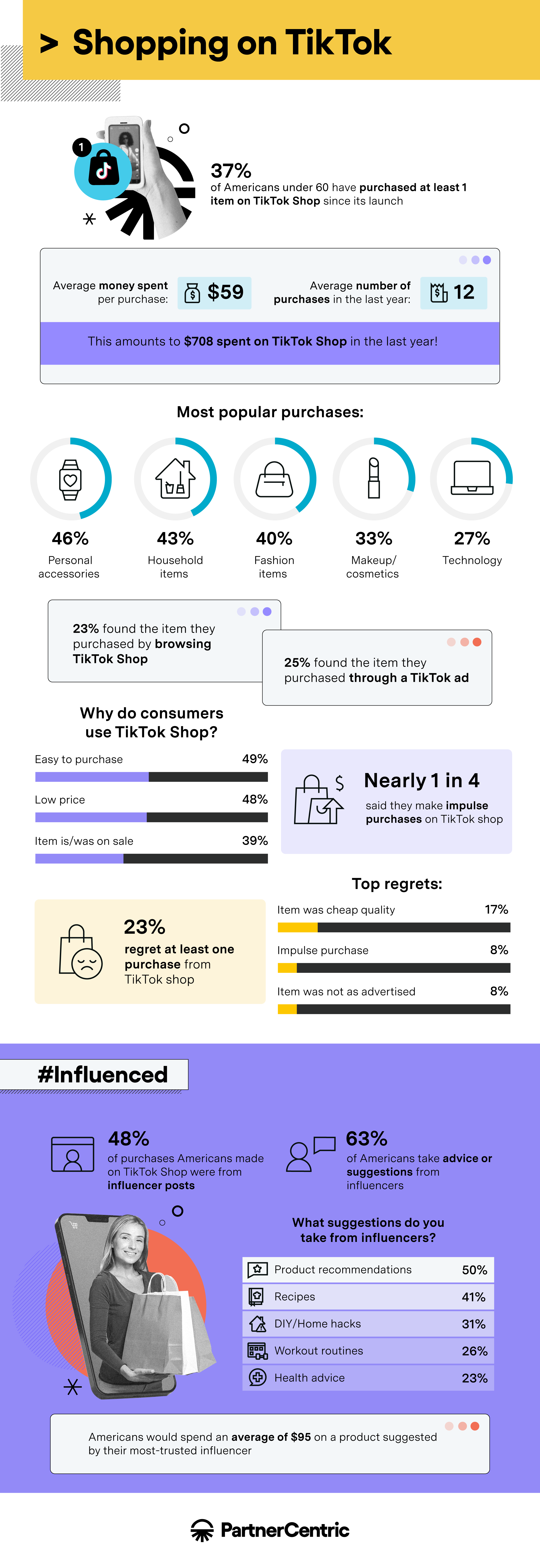
The most popular purchases on TikTok Shop are personal accessories, acquired by 46% of respondents, followed by household items (43%), fashion items and/or clothing (40%), cosmetics (33%), and technology (27%). Nearly 1 in 4 (23%) found the item they purchased by browsing TikTok Shop, and 25% found the item they purchased through an ad on TikTok.
Most consumers use TikTok Shop because it’s easy to purchase on, followed by the low price of many items, as well as frequent sales.
Nearly 1 in 4 also admit the purchase they made was impulsive.This might be why 23% said they regretted at least one purchase from TikTok Shop; top regrets include that the item was a cheap quality, it was an impulse purchase, and the item was not as advertised.
Influencers are Driving Purchases on TikTok Shop
A major consumer trend is embracing the influencer: 63% of Americans under 60 take advice or suggestions from influencers, and nearly half of the purchases they made on TikTok Shop were from influencer posts.
Top suggestions Americans value from influencers include product recommendations (50%), recipes (41%), DIY and/or home hacks (31%), workout routines (26%), and even health advice (23%). The trust runs deep: when asked how much they would spend on a product recommended by their most-trusted influencer, responses averaged $95.
How the “Ban” Affected TikTok Usage and Perception
TikTok is a widely used social media platform; 89% of Americans under 60 use TikTok, and of them, over half use it daily. Unsurprisingly, Gen Zers use TikTok the most, while just over 1 in 3 Gen Xers use the platform daily.
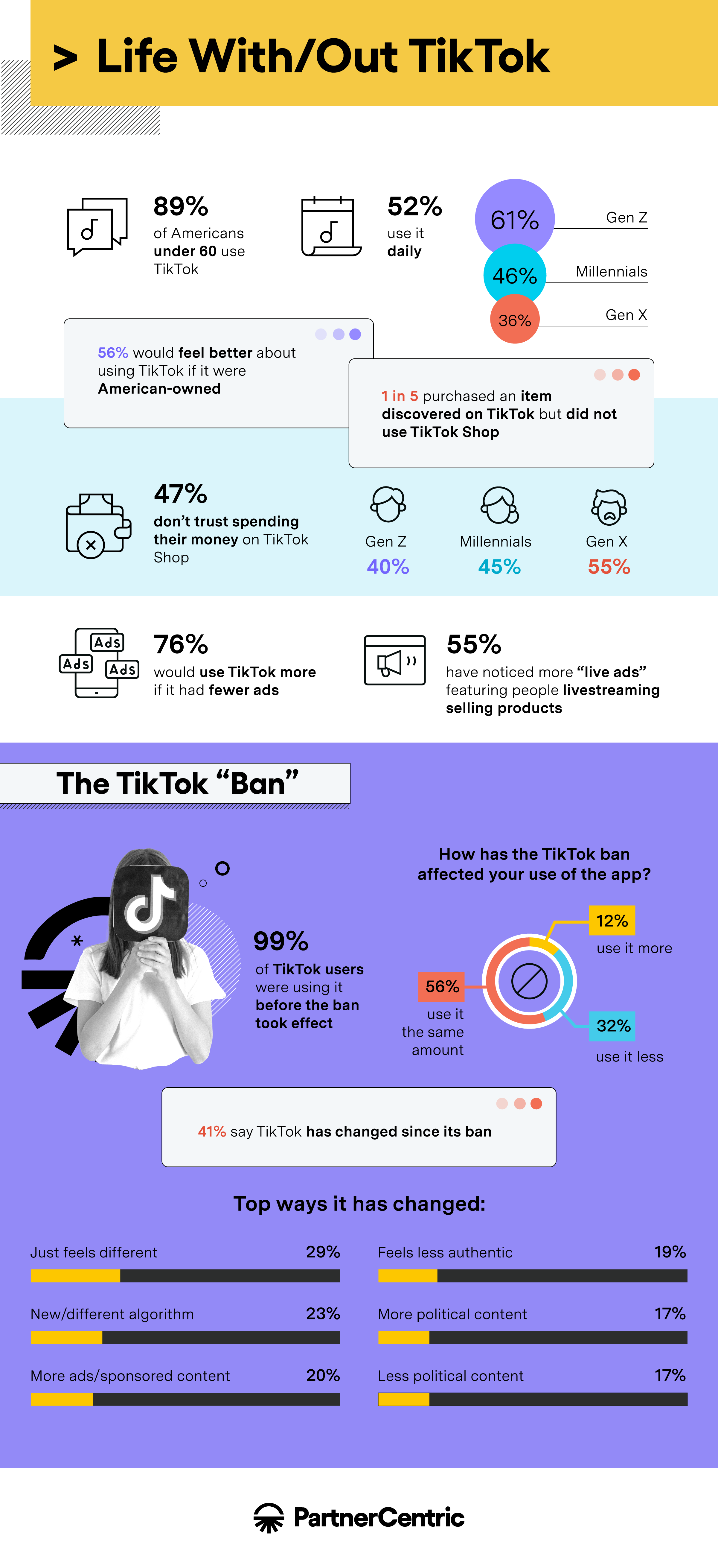
Interestingly, 56% said they would feel better about using TikTok if ByteDance (TikTok’s parent company) divested from the platform and it became American-owned. This distrust follows through in the shopping habits of a few, in that 1 in 5 found an item they discovered on TikTok but chose to purchase somewhere else.
In fact, nearly half of consumers are hesitant to spend money on TikTok Shop, with Gen X being the most skeptical, while Gen Z is the most trusting – as 60% feel confident spending money on TikTok Shop.
Many users report an increase in ads, especially “live” ads featuring influencers or users selling products on a livestream. This technique isn’t necessarily a good tactic as 76% would use TikTok if it had fewer ads; users seem to value authenticity more.
The TikTok “Ban” and Its Effects: 1 in 5 Feel App is Less Authentic
Our statistics show 99% of our respondents were using TikTok when it was temporarily banned in late January; so how did the ban affect usage trends? Among those we asked, 12% said they use the platform more currently, the majority use it the same amount; roughly 1 in 3 (32%) say they now use the social media app less.
A further 32% fully quit TikTok for at least a short period during its ban, but have since returned.
Over 2 in 5 say TikTok has changed since its ban, but it seems that users are conflicted as to exactly how it has changed. 29% say it “just feels different,” while 23% claim that their algorithm changed in some way. Roughly 1 in 5 notice more ads or sponsored content, and a similar amount claim that the app feels less authentic to them. Interestingly,17% of users noticed more political content on their feeds, while the same amount said that they saw less political content.
Gen Z, Influencers, and TikTok
Unsurprisingly, 95% of our Gen Z respondents use TikTok. Most (61%) use it daily, and about 19% use it a few times a week.
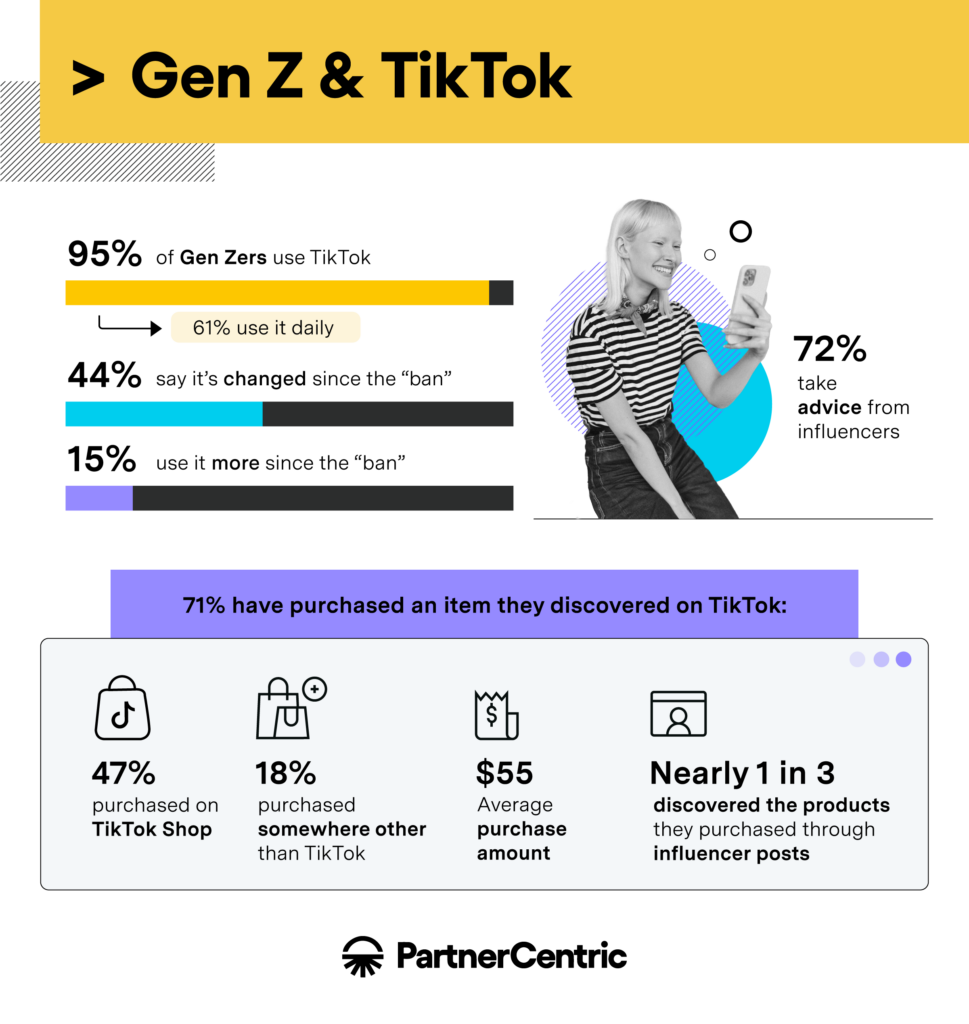
Since the ban, 15% of Gen Z users say they spend more time on the app, even if 44% of them claim that the platform has changed.
Gen Z is in many ways the first generation that fully embraced influencers; it follows that 72% say they take advice from influencers. Gen Zers take this advice to their wallets, as well: 71% purchased an item discovered on TikTok, and of them, 47% purchased on TikTok Shop.
Nearly 1 in 3 Gen Zers discovered the products they purchased through influencer posts; they spend an average of $55 per purchase.
While there’s still stirrings of the return of a TikTok ban, it’s clear that Americans are embracing TikTok and using it to shop. Influencers are a great channel to leverage, particularly to capture the interest, trust, and attention of Gen Z– not to mention their wallets.
Ready to Take the Next Step?
TikTok isn’t just shaping trends; it’s shaping how consumers shop. As creators become trusted commerce channels, brands that build strategic influencer relationships can unlock powerful ROI.
PartnerCentric helps brands navigate the intersection of influencer marketing and affiliate strategy—from identifying the right creators and optimizing campaigns to measuring incrementality through our proprietary FUSE technology. Ready to turn TikTok influence into measurable growth? Let’s talk about your social commerce strategy.
FAQs: TikTok Shop and Influencer Commerce
Q: How popular is TikTok Shop among U.S. consumers?
Very. Over one-third of Americans under 60 have made at least one purchase on TikTok Shop, averaging $59 per transaction and roughly 12 purchases annually.
Q: What are people buying most often?
Top categories include personal accessories (46%), household items (43%), fashion (40%), cosmetics (33%), and tech (27%).
Q: How influential are creators in driving purchases?
Extremely. Nearly half of TikTok Shop purchases were inspired by influencer recommendations, underscoring how creator trust directly translates into sales.
Q: Has the TikTok “ban” affected usage?
Yes. About 32% of users say they now use the app less, while others returned after briefly quitting during the ban. Many also noted an uptick in ads and a perceived decline in authenticity.
Q: How does Gen Z differ from other generations on TikTok?
Gen Z dominates TikTok usage—with 95% active on the app and 72% taking influencer advice. They’re also the most confident shoppers, with 60% trusting TikTok Shop purchases.
Q: How can brands use this insight?
Brands should view TikTok as both a content and commerce ecosystem. Partnering with the right creators—and ensuring transparent, data-driven attribution—helps brands turn creator influence into measurable revenue.
Methodology & Fair Use
In February 2025, we surveyed 1,002 Americans aged 18-60 and under on their opinions and use patterns of TikTok. 50% were men, 49% women, and 1% were nonbinary or did not disclose.
For media inquiries, please contact media@digitalthirdcoast.net
Fair use: When using this data and research, please attribute by linking to this study and citing PartnerCentric.com.
See how Affiliate Marketing helped build a powerhouse brand.
Get In Touch