January 7, 2026
AI Powered Shopping: 64% Planning on Using AI Shopping in 2026

AI chatbots like Gemini and ChatGPT changed the face of being online: whether it’s chatting for information or leveraging a robot to write emails, generative AI continued its meteoric rise across the internet and particularly in the marketing world.
One notable development was the advent of using AI chatbots to shop online: rather than search for products or go through review or affiliate websites, consumers flocked to chatbots to unearth deals, find personalized recommendations, and take inspiration for buying gifts for loved ones.
According to Reuters, AI influenced just over $14 billion in online sales on Black Friday– showing the incredible potential of this new way to shop. With this in mind, we wanted to learn more about how AI is used in shopping by consumers: why, how, and what they’re planning on doing in 2026. Here are our findings from our survey of over 1,000 consumers on AI shopping.
Half of Americans Tried AI Shopping in 2025
2025 was the year of AI-powered everything, and shopping was no exception. Nearly half of consumers (49%) report AI use in shopping at some point in 2025, with 11% saying they tried it for the first time while holiday shopping. Most turned to ChatGPT to do so, with 61% expressing preference for OpenAI’s near-ubiquitous chatbot.
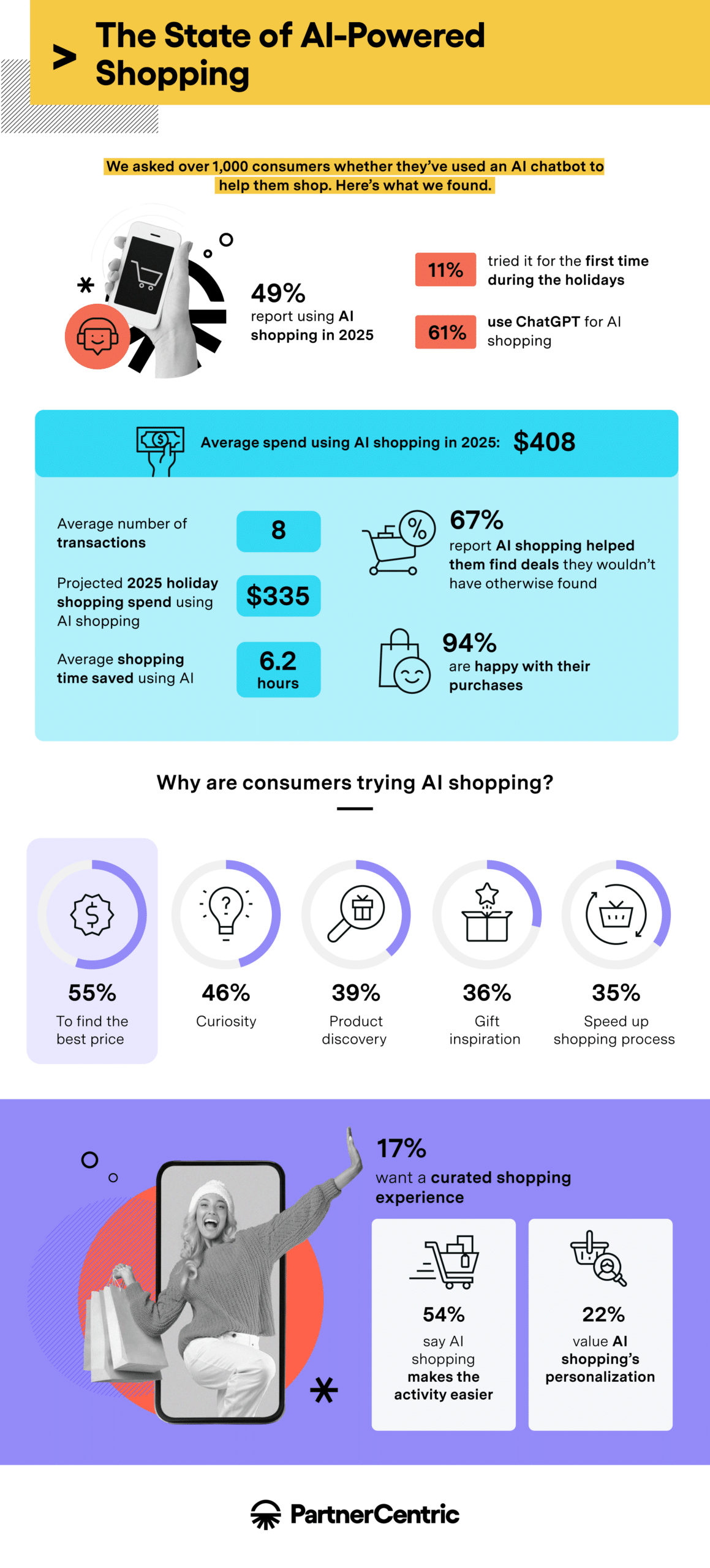
Overall, consumers spent an average $408 in 2025 using AI shopping, spread across roughly 8 transactions. This survey, conducted on December 16, also predicted a cumulative spend of $335 on holiday shopping using AI.
How did consumers like their experience? Two thirds say AI helped unearth deals they wouldn’t have otherwise found, and a huge 94% are happy with their purchases. This is not in small part because they report saving an average of 6.2 shopping hours due to their AI use.
How is AI used in shopping? Consumers report trying AI shopping primarily to find the best price (55%), curiosity (46%), and for product discovery (39%), with another third citing gift inspiration as a motivating factor. Just over 1 in 6 want a curated shopping experience, and 22% value AI’s capacity to personalize recommendations. Overall, 54% say using AI for shopping makes the activity easier for them.
Top Pros of AI Shopping
- Recommendations 73%
- Speed 60%
- Makes shopping easier 54%
- Synthesizes reviews 29%
- Relieves stress of shopping 22%
Interestingly, many consumers appreciate that AI reduces overall decision fatigue, which causes stress.
Only 12% regretted a purchase made using AI shopping, but a similar number did report that using AI chatbots to shop made them spend more than they originally planned.
How are Consumers Using AI in Shopping in 2026?
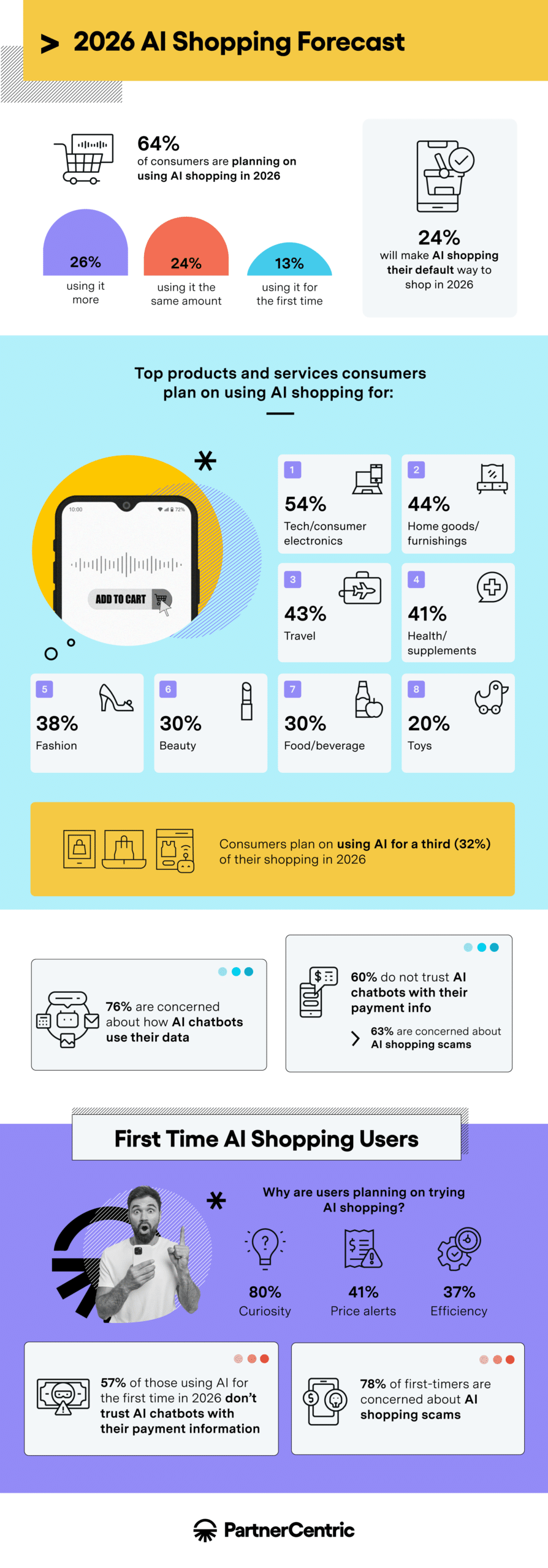
AI shopping is here to stay– and here to grow. 64% – nearly two thirds! – of consumers are planning on using AI chatbots for shopping in 2026, with 26% planning on using it more, 24% using it the same amount as 2025, and 13% planning on trying it for the first time. Furthermore, nearly 1 in 4 are planning on making AI shopping their default way to shop in 2026.
Top 5 Products & Services Consumers will Use AI Shopping For in 2026
1. Tech/consumer electronics 54%
2. Home goods/furnishings 44%
3. Travel 43%
4. Health/supplements 41%
5. Fashion 38%
Other notable categories include beauty (30%), food/beverages (30%), and toys (20%).
Overall, consumers are planning on using AI for about a third of their shopping in 2026, but not without caution: 76% are concerned about how chatbots use their data, and 60% don’t trust chatbots with their payment information. One contributing factor? AI shopping scams, which concern 63% of respondents.
First-Time AI Shopping Users Tell All
Given that over 1 in 10 consumers are planning on trying AI shopping for the first time in 2026, we wanted to know why. Over 4 in 5 report wanting to try chatbot-assisted shopping largely due to curiosity, with leveraging price alerts (41%) and efficiency (37%).
While many are looking to try this new way to shop, most are cautious: 57% of these first timers don’t trust chatbots with their payment info, and an overwhelming 78% are concerned about scams, showing a stark need for robust security within the AI ecosystem– even if only 2% reported being victims of a scam.
78% think AI Chatbots are Already Influenced by Advertisers and Brand Partnerships
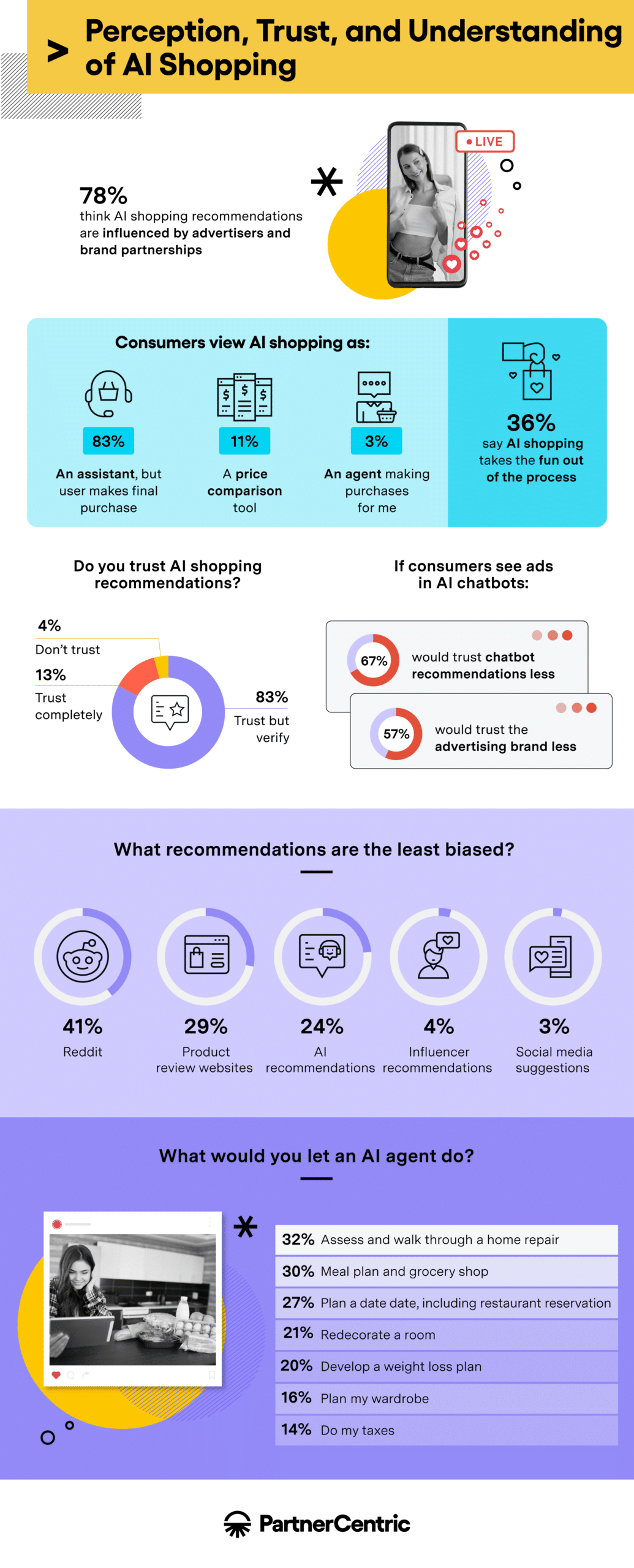
One major takeaway from our consumer survey was that consumers see advertisers and brand partnerships – even in places they’re technically not (yet). Over three in four (78%) believe that AI shopping recommendations are influenced by advertisers already, which is not, as of January 2026, true. On the other hand, 47% trust chatbots to give them the best answers.
Other notable perceptions include how AI chatbots are understood in the context of shopping: while only 3% consider AI chatbots to be an agent making purchases autonomously, most (83%) consider their chatbots to be assistants that surface options, but the user goes through with the purchase process. A further 11% view AI chatbot-powered shopping as a price comparison tool. Relatedly, 36% say AI shopping takes the fun out of the activity for them.
Overall, consumers trust AI chatbot recommendations, with 83% reporting that they “trust but verify” recommendations and 13% go so far as to trust them categorically. Only 4% distrust the process.
However, the equation changes with the introduction of ads: if consumers see ads in their AI chatbot shopping recommendations, 67% would trust the recommendations less, and 57% would also penalize the advertising brands.
While AI shopping is generally trusted, there is still a perception of bias– when we asked consumers to rank their least biased sources on the internet, Reddit came out on top with 41% of votes, followed by product review websites (29%), AI recommendations (24%), and influencer recommendations. Social media suggestions are a distant 4 and 5, with 4% and 3% of votes respectively.
Additionally, AI shopping is only the third most-preferred method of shopping, after going on a major ecommerce site and shopping on a specific brand site.
What would consumers let an AI agent do?
In many ways, AI shopping is a peek into a future where AI assistants help consumers do all kinds of things. We wanted to see what other activities consumers were willing to outsource to their chatbots, and here were some highlights:
- Walk through home repairs (32%)
- Meal plan/grocery shop (30%)
- Plan a date, including restaurant reservation (27%)
- Develop a weight loss plan 20%
- Plan a wardrobe 16%
- Do taxes 14%
How Overall AI Use Affects AI Shopping Patterns
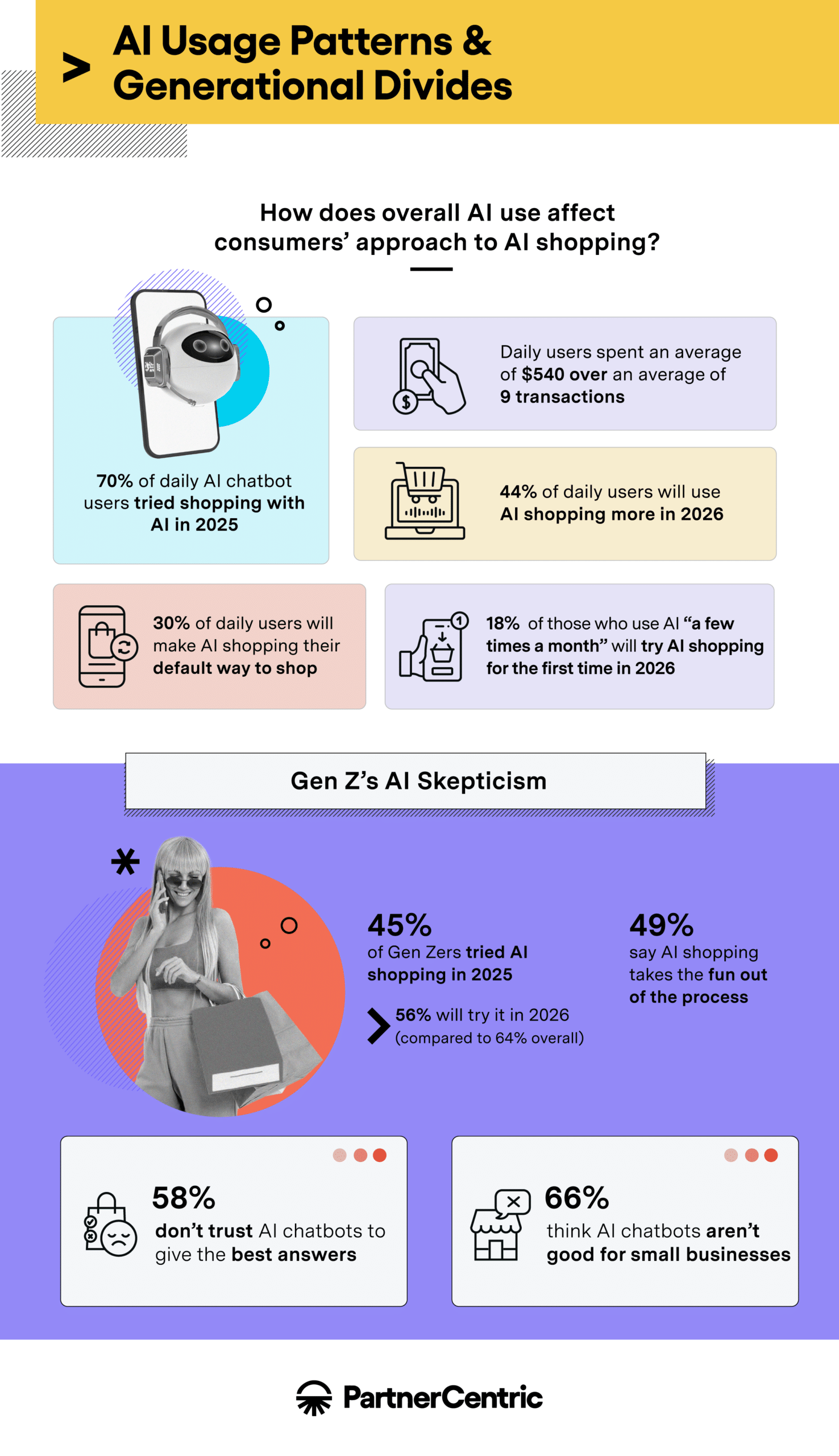
We dug deeper into the data to see whether AI power users were approaching their AI-powered shopping differently. Those who use AI daily were more likely to have tried AI shopping in 2025: 70% reported doing so, spending an average of $540 across 9 transactions.
Not only that, but 44% of daily users will be using AI shopping even more in 2026, and 30% are planning on making AI chatbots their default way to shop.
In contrast, just under 1 in 5 intermittent AI users (“a few times a month”) will be trying AI shopping for the first time in 2026, demonstrating a gulf between frequent and infrequent AI users.
Gen Z: AI Shopping Skeptics
While Gen Z might be the most AI native generation in the workforce, it takes technology with a grain of salt. While 45% tried AI shopping in 2025, only 56% are planning on using it in 2026 compared to 64% overall. Half of Gen Zers (49%) say AI shopping takes the fun out of the process, and 58% say they don’t trust AI chatbots to give them the best answers. Additionally, 66% are skeptical that AI chatbots and shopping is good for small businesses.
AI Shopping is a Huge Opportunity– if Done Carefully
Our survey results show that AI shopping made a huge entrance in 2025 and will only be picking up steam in 2026, which means there’s never been a better time to ensure your brand and products have proper visibility across multiple channels, from social networks like Reddit to citations in ChatGPT and presence on the right sites driving the right traffic.
Gone are the days of browsing department stores, but finding ways to make shopping fun will be the key to capture jaded Gen Zers and keep first-time chatbot shoppers excited about purchasing.
Methodology & Fair Use
On December 16-17, 2025, we surveyed 1,004 consumers on their usage of AI chatbots in shopping and product discovery. 48% were women, 50% men, and 2% were either nonbinary or chose not to disclose. Ages ranged from 18-78 with an average age of 45. 21% reported daily AI use, 32% a few times per week, 39% weekly or less, and 7% reported never using AI.
For media inquiries, please contact media@digitalthirdcoast.net
Fair use: When using this data and research, please attribute by linking to this study and citing PartnerCentric.com.
Ready for better
This form is protected by reCAPTCHA and the Google Privacy Policy and Terms of Service apply.